What's In Store at Wrightslaw?

Special Ed Law & Advocacy Training (6.5 hrs)
25% Off the Wrightslaw Bundle of 4 PRINT books for $58.35 (Sorry, coupons not accepted on this product)
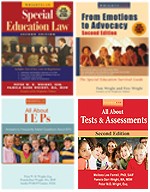
Includes Wrightslaw: Special Education Law, 2nd Ed., Wrightslaw: From Emotions to Advocacy, 2nd Ed., Wrightslaw: All About IEPs and Wrightslaw: All About Tests and Assessments, 2nd Ed.

New! The Wrightslaw Bundle is now available as an immediate PDF download. All four Wrightslaw books as PDFs for just $49.95!
|
Wrightslaw: From Emotions to Advocacy
The Special Education Survival Guide by Pam Wright & Pete Wright |
|
||
|

"If you think education is expensive, try ignorance." -- Benjamin Franklin The
second section of Wrightslaw:
From Emotions to Advocacy is Advocacy 101. "You will learn about
gatekeepers, special education teams, and one-size-fits-all (OSFA) programs. When
you learn the rules of the game, you will be a more effective advocate and negotiator
for your child." (From
Emotions to Advocacy, page 23) If you are like many
parents, emotions are your
Achilles heel. In Chapter 7, you learn the most
common causes of parent-school crises -- why parents ask for help. We provide strategies
for long-term planning and short term relief. More Articles About Advocacy Emergency!
Crisis! Help! Classic article for parents about dealing with a crisis. From
Emotions to Advocacy: The Parent's Journey. Classic article about dealing
with your child's disability and how to manage your emotions. Mistakes
People Make: Advocates. Because
the non-lawyer advocate plays an extremely important role in the special education
process, advocates must be mindful of their power and the trust parents place
in them. The more serious mistakes advocates may make are generally ones of excess
. . . Read article Mistakes
People Make - Schools. Anything a school system does that undermines parents'
trust creates a climate that is costly in dollars, time, peace of mind, and the
quality and success of services given to the child. This article describes the
most common mistakes school systems make. Wrightslaw:
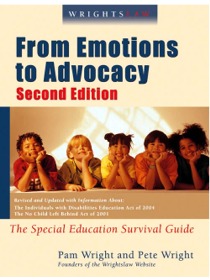
From Emotions to Advocacy, 2nd Edition Wrightslaw:
From Emotions to Advocacy, 2nd Edition- The Special Education Survival Guide (ISBN 1-892320-08-8) by Pamela Wright and Peter Wright has hundreds of tips, strategies,
references, warnings and Internet resources. This practical, user-friendly book
includes:
Advocacy 101

Resources by Chapter
In Chapter 4, you learn
about "the school" - about school districts, school teams, and
the mission of public schools. You also learn
the "rules of the game."
You learn how schools and
school teams operate, how to recognize
gatekeepers and why schools develop one-size-fits-all (OSFA) programs.
You learn "10 Reasons
Why Schools Say No!"
Chapter 5 is all about obstacles
to success. School obstacles include attitudes
and beliefs and the power
of school culture.
When school personnel lose perspective, retaliation
can become a serious problem.
You also learn about parent obstacles,
including lack of accurate information, isolation, emotions. Read about the Intimidation
Factor.
We suggest that you join a parent group and offer suggestions
about finding a group that meets your needs.
In Chapter 6,
you learn why parent-school
conflict is normal and predictable. You discover the most common causes
of conflict. We offer strategies
to resolve conflict and disputes without damaging or destroying the parent-school
relationship.
Learning
Problems: Who is to Blame? Why do parents feel defensive at school meetings?
Why is parent blaming so pervasive? This article about school culture answers
these questions.
Mistakes People Make: Independent Evaluators. To
make their case for services or a specific program for their child, parents usually
need a competent, credible independent evaluator. Serious mistakes by evaluators
can make undermine their credibility or render their opinions powerless. To learn
about mistakes independent evaluators should try to avoid, read
this article.
Mistakes People Make - Parents. Because the stakes are so high, it is
difficult for parents of children with special educational needs to advocate calmly
and objectively for the educational and related services their children need.
Read this article to learn about the mistakes parents make.
School
Principals Views of Children with Learning Problems. Researchers find
that principals share stereotypes and prejudices of mainstream culture. Regardless
of children's problems or needs, two solutions are offered -- retention and referral
to special ed.
Copyright © 1998-2022, Peter W. D. Wright and Pamela Darr Wright. All rights reserved. Contact Us