What's In Store at Wrightslaw?

Special Ed Law & Advocacy Training (6.5 hrs)
25% Off the Wrightslaw Bundle of 4 PRINT books for $58.35 (Sorry, coupons not accepted on this product)
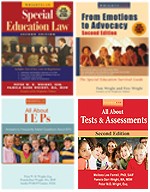
Includes Wrightslaw: Special Education Law, 2nd Ed., Wrightslaw: From Emotions to Advocacy, 2nd Ed., Wrightslaw: All About IEPs and Wrightslaw: All About Tests and Assessments, 2nd Ed.

New! The Wrightslaw Bundle is now available as an immediate PDF download. All four Wrightslaw books as PDFs for just $49.95!
Success Story: Plans Are Our Safety Net
 Laura
and Steve have four children. Their youngest child is Justin who is
15. Justin has autism. Laura and Steve have encountered obstacles in
their son’s education from the beginning. Today, Justin attends
his local high school, takes general education courses, and earns “A’s”
in art and wood shop.
Laura
and Steve have four children. Their youngest child is Justin who is
15. Justin has autism. Laura and Steve have encountered obstacles in
their son’s education from the beginning. Today, Justin attends
his local high school, takes general education courses, and earns “A’s”
in art and wood shop.
Laura and Steve describe the importance of planning.
Do we have a clear view of what we want for our son? Yes.
We started out, as many parents do, with
goals and aspirations for our son. With the diagnosis of autism, we
had to modify what we saw as the path for his future. We had to get
through the grieving process before we could look forward to a future
for our son.
Forming a plan and thinking about possibilities for his future helped
us to heal and to adjust our perspective in a positive way. We did not
give up our vision; we modified it.
When you
have a child with a disability, you battle with insurance companies
and schools, negotiate with employers and co-workers for time off, respond
to the needs of family members, and deal with the unexpected. As these
demands increase, your stress level increases too. It is easy to be
sidetracked and forget what is important.
What keeps us sane? Planning! I
cannot emphasize this enough for parents.
A master plan helps us stay focused, anticipate problems, and prepare
for the future. Our master plan includes goals for our son in academic
and non-academic areas – hobbies, interests, sports, play, and
friendships. Master plans are clear, focused, concise, and flexible.
We make lists of expectations. We write out our goals. We post outcomes of what we want to see happen.
We have a plan for our son. We also have contingency plans. Plans are my emotional safety net. If things do not go as expected, we have plans to fall back on. We make the best of the present situation or make temporary fixes until we can put changes into place.
We realize that Justin may never be completely independent. We plan for that too. When you have a special needs child, you have to modify your expectations more often. Sometimes there are obstacles you do not see until it is too late.
Our main goal has always been for Justin to have the most fulfilling life possible. We broke this down into several areas. In the beginning, our goals were very basic – like communicating and cleaning his room. During modification times, we add to these goals. Now, some of our goals for him are:
-
Life skills: cooking; cleaning; personal hygiene
-
Social skills: answer phone; greet people
-
Communication: express wants, needs, desires
-
Job skills: develop talents and interests; identify fields of employment
Now we include the word “functional” in goals. When developing Justin’s IEP, we bring a list of outcomes for his life that we developed. When the teachers list a goal, we look to see how it connects with these outcomes and if it is “functional.” We also bring our list of educational expectations for the year. We have found that many teachers appreciate a list of ideas.
Copyright © 1998-2022, Peter W. D. Wright and Pamela Darr Wright. All rights reserved. Contact Us